All you need to know about TRACES before your EUDR deadline

📌 ESG researcher Shubhra Dixit has compiled a useful guide on what companies need to know about TRACES before the EUDR deadline on 30 December 2026.
All you need to know about TRACES before your EUDR deadline
From December 30, 2026 onwards organizations will need to prove their compliance with the EU Deforestation Regulation. This is a hard deadline, meaning that if organizations cannot provide evidence for their compliance in the form of a Due Diligence Statement (DDS) they risk a series of possible penalties.
The DDS needs to be submitted and accepted to the EU Commission's TRACES NT platform. This article provides an overview of what you need to know about TRACES, and what you need to navigate it successfully.
1. What is TRACES
2. Do you need a TRACES account?
3: Setting up an account in TRACES
4: If you don't have a TRACES account by 30/12/2026
5: How can MasterSustainability.today help with TRACES?
1: What is TRACES
TRACES is the EU Commission's official platform for the submission and tracking of certifications relating to the health and sanitation of animal and plant products moving through the EU market.
It was originally launched in 2004 to manage the EU's stringent sanitary and phytosanitary certification (SPC) requirements, and now has around 100.000 users in over 90 countries.
That means that if your business has dealt with the importation of live animals, plants, animal feed, or animal and plant products for human consumption, there's a good chance you've already used TRACES for your documentation before.
In 2024, they started testing a new tool for TRACES called the Information System. This tool was developed to track compliance for products falling under the EU Deforestation Regulation (EUDR). For an in-scope product to be able to enter the EU market after the EUDR implementation deadline, a Due Diligence Statement (DDS) promising compliance has to be submitted, accepted, and linked with a TRACES-generated reference numbers.
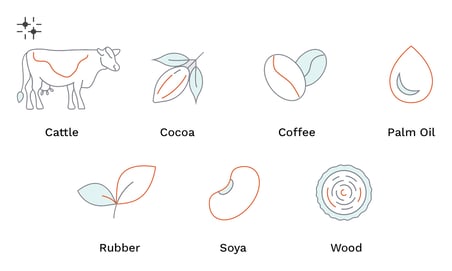
The following commodities and their derived products are in scope for the EUDR: cattle, cocoa, coffee, palm oil, rubber, soya, and wood
For LMEs and enterprises already impacted by the EU Timber Regulation (EUTR), the EUDR implementation deadline hits on 30 December 2026. For small and micro enterprises the implementation deadline is 30 June 2027.
Regardless of when your deadline hits, we recommend getting acquainted with the TRACES process as soon as possible. It's likely not something you're going to get right on the first try, and if you're curious about what happens to businesses who aren't fully compliant by their deadline read our article EUDR in 2026: What you risk with non compliance.
Note: we refer to the platform as TRACES throughout the article. Here are two points we need to clarify:
1. When we use the term TRACES, what we're specifically referring to is TRACES NT. Don't let the NT confuse you - that's what they call the updated platform that is currently in use. TRACES Classic was decommissioned in 2022, so there's no risk of confusing where you need to be.
2. The Information System is a tool in TRACES that is dedicated to managing EUDR data. Depending on where you're looking for information, you'll find either term being used. Read about how the two differ in section 3: Setting up an account in TRACES.
2: Do you need a TRACES account?
The EU Deforestation Regulation (EUDR) has divided the chain into a set of roles. A brief recap, for those who need a refresher:
-
- Upstream Operators place commodities and/or products affected by the EUDR on the EU market for the first time.
- Small and Micro Upstream Operators have the same function as normal Upstream Operators, but their enterprise does not exceed two of the following three limits: a balance sheet total of €5 million, a net turnover of €10 million, and an average of 50 employees (for micro undertakings: €450,000, €900,000 and 10 employees).
- Downstream Operators transform products and/or commodities already covered by a DDS or Simplified Declaration and introduce the new product to the market for the first time.
- Traders deal in products that have already been imported or produced within the EU market.
There might be a little confusion as to who exactly needs a TRACES account. If TRACES is only used for the submission of the DDS and Simplified Declarations, then surely they're the only ones needing a TRACES account?
Not necessarily. Submitting a DDS or Simplified Declaration to TRACES generates a unique reference number that follows a product subject to the EUDR throughout its lifecycle.
Downstream Operators who use these products need to verify that they are linked to a valid DDS or Simplified Declaration, collect the reference numbers, and store them for audit. They might be taking a clog and presenting a glass slipper, but the clog is what interests the auditors.
Traders have a relatively passive role in EUDR compliance. They aren't expected to go sleuthing to see whether the supply chain has any weak compliance links. They don't have to submit any compliance documentation of their own. They don't have to do any risk assessment. They do need to alert authorities if they think compliance is in question, and if they purchase from Upstream or Downstream Operators, they need to collect the DDS and Simplified Declaration reference numbers.
Do I need a TRACES account?
| Upstream Operators | YES, as you need to formally submit a Due Diligence Statement (DDS) for every commodity or product you're placing on the EU market. |
| Small and Micro Upstream Operators | YES, as you need to formally submit a DDS or Simplified Declaration for every commodity or product you're placing on the EU market. |
| Downstream Operators | YES, as you need to collect the reference number of every DDS and Simplified Declaration |
| Traders |
YES, if you purchase from Upstream or Downstream Operators, NOT NECESSARILY if you purchase from other Traders. |
3: Setting up an account in TRACES
Setting up a TRACES account is a multiple day process even in the most expedient scenario. Leaving it to the eleventh hour is therefore not advisable.
Getting a TRACES account includes:
1: Creating an EU Login account
Unless you have one already! If your EU Login account is linked to your operator (an operator in this context being a business, organization, company, legal entity, etc.), then you will ultimately have access to the TRACES account associated with that operator.
Creating an EU Login account can be done easily and quickly. It is important to note that the EU Login requires a two factor authentication.
2: Registering to the TRACES NT EUDR module
If your operator (an operator in this context being a business, organization, company, legal entity, etc.) already exists in the TRACES NT database (IMSOC) you can request your administrator to validate your authorization request. This can take a couple of working days, and it can also result in issues that need some time to get fixed.
If you're absolutely sure that your company doesn't exist in IMSOC, then you can add it to the database. It is possible for operators to exist in duplicates in the system, which often results in missing, fragmented data.
3: Register for both the Acceptance and Production Servers
There are two servers within the EUDR module: the Acceptance and Production Servers.
The Acceptance Server is a replica of the Production Server that companies can use for training and to test that their data formats are compatible with the requirements.
The actions undertaken in the Acceptance Server have no legal validity. This means that you can be happy with all the components of the DSS you've submitted to this server, but it still needs to be submitted to the Production Servers for your product to enter the EU Market.
The Production Server is where all the completed DDS and Simplified Declarations get submitted. Once accepted, these are legally binding and can be checked by authorities.
4: Making sure you know how to use the platform
Using TRACES isn't necessarily intuitive, which is why the EU Commission has not only organized in depth video guides, but has also planned several training days.
Check out their Information System Overview Page for more information on their training resources!
4: If you don't have a TRACES account by 30/12/2026
The EU Deforestation Regulation (EUDR) deadline hits on 30 December 2026 for LMEs & enterprises already impacted by the EU Timber Regulation (EUTR). Small and micro enterprises get a little more time to prepare their compliance documentation, with a deadline of 30 June 2027.
These are hard deadlines, with no grace period. That means that the submission and acceptance of the DDS needs to be completed before these dates if the product needs to circulate on the EU market.
That means that you should not only have a TRACES account by the deadline, but you should know how to navigate the system and have actively been submitting your data to it.
The EUDR has a clearly defined penalty framework, and it's quite harsh. It can result in the confiscation of your product, significant fines, and reputational damage. An in depth look at the expected penalties can be found in our article "EUDR in 2026: What you risk with non compliance."
5: How can MasterSustainability.today help with TRACES?
MasterSustainability.today supports organizations in the digitization of their EUDR process, from data collection and supply-chain collaboration to audit preparation and TRACES-submission.
Your company will still have to register with TRACES, but after you've given us authorization we will be able to submit all the data necessary for a successful DDSs.
By streamlining your compliance process with MasterSustainability.today you eliminate the risk of incomplete or incompatible data, giving you the space to focus on the beautiful aspects of ESG management.
Interested in our EUDR solution? Check out our brochure.
SOURCES
TRACES - Food Safety - European Commission
Frequently Asked Questions: Traces - Food Safety - European Commission
The Information System of the Deforestation Regulation - Green Forum
How do I create my EU Login account? - EU Login Portal - European Union