The EUDR Due Diligence Statement (DDS) explained [Updated July 2026]

![The EUDR Due Diligence Statement (DDS) explained [Updated July 2026]](https://www.mastersustainability.today/hs-fs/hubfs/Adoption.jpg?width=950&name=Adoption.jpg)
📌This article, written by ESG researcher Shubhra Dixit, provides a clear overview of the DDS, the due diligence statement required as per the EUDR, the deforestation regulation, explaining its scope, goals, compliance requirements, penalties, and key deadlines
Everything you need to know about the EUDR due diligence statement [Updated July 2026]
The European Union Deforestation Regulation (EUDR) establishes a strict due diligence framework to ensure that certain commodities and derived products entering or leaving the EU market do not contribute to deforestation, forest degradation or illegality. A central component of this framework is the due diligence statement, commonly referred to as a DDS. This statement is not a policy narrative, but a formal, legally binding declaration submitted digitally before products are placed on the EU market or exported.
A DDS consolidates traceability data, risk assessments and compliance attestations into a single submission. It is the core compliance document used by market surveillance authorities to verify that operators have exercised due diligence as defined by the EUDR.
NOTE: This article was originally published in December 2025, but was updated in July 2026 in response to the May 4 2026 Simplification Review. If you need a full guide to what the Simplification Review actually means for your organization, read our Simplification Debrief.
What is a Due Diligence Statement (DDS)?
A DDS is a structured compliance declaration submitted within the EU Information System. It confirms that the submitting company has completed all mandatory due diligence steps, including product traceability to plot level, risk assessment across the supply chain, any necessary mitigation actions and a final determination that residual risk is negligible.
These references to the due diligence steps need to be backed by data that won't be included in the DDS itself, but which will need to be made available to auditors at any moment. As a result the DDS is not merely a matter of filling out paperwork, but getting your data chain in order.
Once submitted, the DDS is legally binding and becomes part of the operator’s audit trail. Any inaccuracies or omissions can result in penalties under national enforcement regimes.
What the DDS must contain
The EUDR sets out a specific list of information that must be included in a DDS:
- Operator or trader identification: The legal entity submitting the DDS, including name, address, country, ISO code and EORI number where applicable.
- Activity description: Whether the company is importing, exporting or placing the product on the EU market.
- Commodity and product information: Including CN codes, product descriptions, quantities, scientific names, common names, and associated producer and country of production details.
- Traceability information: Geolocation to the plot level and harvest data. This ensures traceability of the commodity back to its origin.
- Supply chain information: Names of producers and documentation linking batches to supply chain actors.
- Risk assessment and mitigation: A summary of the assessment of eight risk categories under Article 10 and any necessary mitigation measures.
- Submission and audit trail: Timestamps, amendments, status history and users involved in preparing or modifying the DDS.
What a Due Diligence Statement looks likes: example, structure & explanation
Below is an actual DDS, broken down into 4 sections for the sake of explaining each component and how it fits into the regulatory requirements.
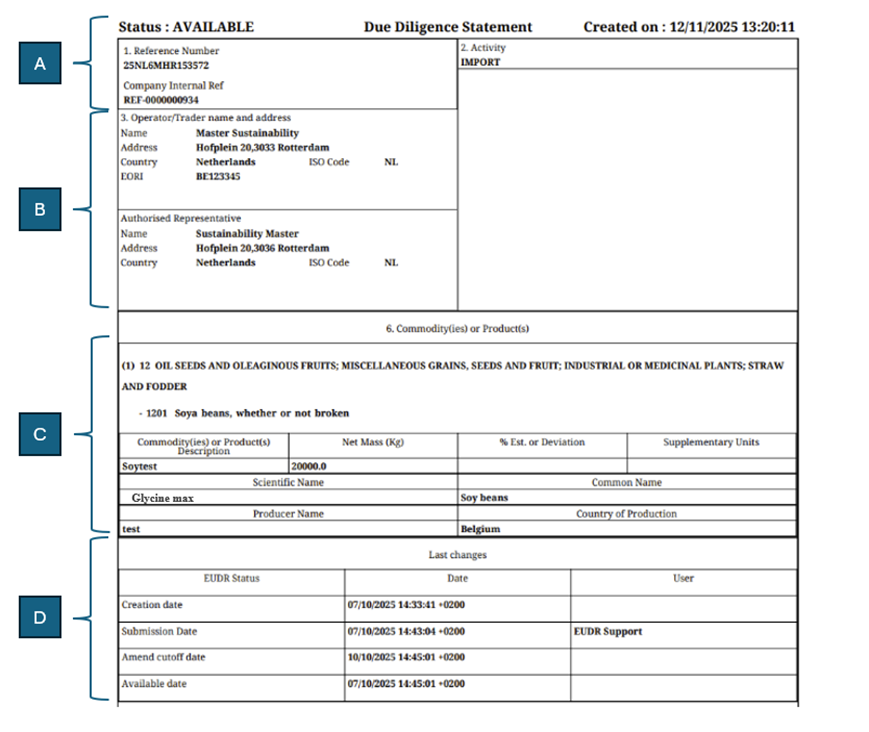
Section A
This displays the current state of the DDS (in this case, available), along with the creation timestamp. It is essential for auditability and for customs or market surveillance authorities to verify when the statement became valid. The DDS includes a unique EUDR reference number (required) and an optional internal company reference. The EUDR number uniquely identifies the DDS within the EU system. In this example, the activity is “Import”. This determines the role the company plays under the EUDR and confirms that it is an operator placing products on the EU market for the first time.
Section B
This section identifies the legal entity responsible for placing the product on the market. It confirms the company name, legal address, country, ISO code and EORI number. This information anchors legal accountability. We also see who is authorised to act on behalf of the operator. It is required when the responsible person differs from the legal entity's primary contact or when a mandate is delegated.
Section C
Here is specified the regulated product. The DDS lists the HS chapter, CN code, scientific name, common name and net mass. It also records producer name and country of production. This is essential for linking the product to its origin and for identifying which supply chain actors are involved. Scientific names must match the commodity in question; inconsistencies can trigger questions from authorities. In this case, Glycine max matches the soy product. Here we also see the upstream producer. The EUDR requires transparency in every supply chain stage, from producer to operator. The example lists Belgium as the country of production.
Section D
The log of creation, submission, amendment deadlines and availability dates is part of the regulatory audit trail. It shows who performed each action and when. Authorities use this to verify timely submission, adherence to amendment windows and potential red flags in revision history.
What is not shown in this DDS
This example does not include geolocation or risk assessment sections, which are mandatory in a complete DDS. In practice, these appear in other pages or digital fields of the system. They include polygon coordinates, risk scoring details and any evidence used for mitigation.
Who must submit a DDS?
A DDS must be submitted on the TRACES platform, which is the European Union's official platform to submit due diligence statements. It is necessary to do this before the product is released for free circulation or exported; entering an in-scope product or material onto the EU market without a submitted DDS and its TRACES-generated reference number results in penalties and removal of the product from the market.
Under the European Deforestation Regulation it is the Upstream Operators who need to submit a due diligence statement. Upstream Operators place in-scope materials or products on the EU market for the first time. The rest of the supply chain -- this includes Downstream Operators and Traders -- aren't required to submit a DDS report, but they are expected to make sure the products they deal with are EUDR compliant.
If you're having trouble identifying which role you play in the EUDR supply chain, consult our brochure for guidance.
Why the DDS matters
The DDS is central to the enforcement of the EUDR. It documents:
- Traceability of the product to the plot of origin
- Evaluation of deforestation and legality risks
- Mitigation of any non-negligible risks
- The legal attestation of negligible residual risk
Customs and market surveillance authorities rely on the DDS to determine compliance, cross-check supply chain claims and initiate enforcement actions where needed.
A due diligence statement under the EUDR is a mandatory, legally binding declaration that consolidates traceability data, supply chain information, risk assessment and final compliance conclusions. Ensuring accurate, complete and traceable DDS submissions is essential for maintaining lawful access to the EU market and demonstrating compliance with one of the most stringent environmental due diligence regimes worldwide.
Where to begin creating a DDS
MasterSustainability.today offers organisations a tailored digital solution for all their EUDR needs. This includes data collection, supply chain collaboration, and DDS generation.
Let an expert reduce your DDS complexities. Reach out to MasterSustainability.today for a customized solution for your EUDR journey.
Sources:
TRACES - Food Safety - European Commission
EU Deforestation Regulation (Regulation - 2023/1115)
.png?width=50&name=Image%20(2).png)